Why Importers Should Not Source SPC Flooring by Price Alone
The lowest FOB price can hide higher costs in claims, unstable batches, slow reorders, and mismatched specifications.
SPC flooring is usually purchased by container, not by carton, so one wrong specification can become a 20-foot container problem. For importers and distributors, price only matters after the product has the right wear layer, click profile, dimensional stability, packaging strength, and documentation for the target market.
A better sourcing process starts with application fit: residential retail, apartment turnover, light commercial, hospitality, or project bidding. Each use case needs a different balance of total thickness, wear layer, IXPE/EVA backing, décor repeat rate, carton weight, pallet loading, and warranty language.
What to ask your supplier/vendor: “Which specification do you recommend for my market segment, and can you show past shipment records for similar customers?”
Why this matters now
SPC buyers are under pressure to control landed cost while reducing post-sale claims.
Importers are facing tighter buyer expectations: faster sample approval, cleaner documentation, stable color matching, and fewer installation complaints. A small mismatch in locking strength or dimensional stability may not appear during sampling, but it can become visible after 3–6 months of jobsite use, especially in rooms with sunlight exposure, temperature variation, or uneven subfloors.
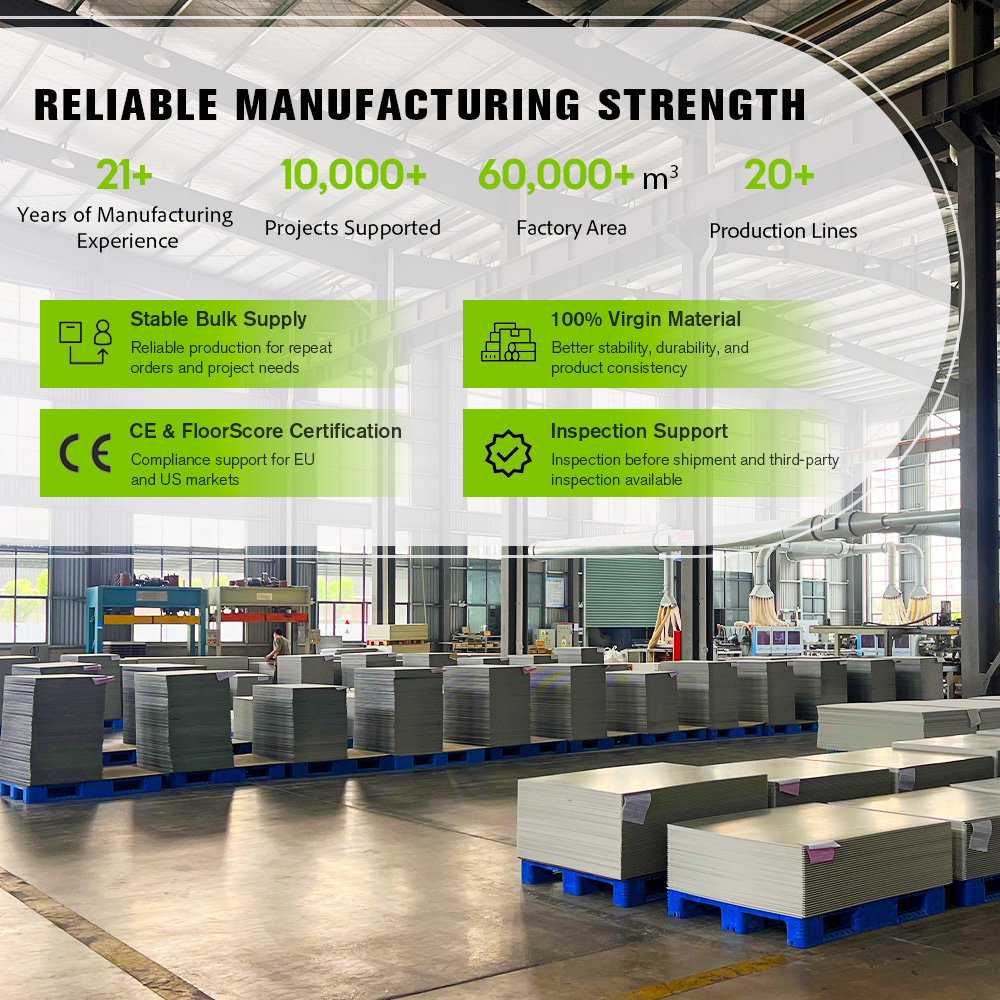
At the same time, many distributors are reducing inventory risk. Instead of ordering broad ranges blindly, buyers want suppliers that can support repeatable SKUs, private label packaging, mixed-color container planning, and batch consistency. Anyway Floor’s stated production setup — 60,000 sqm factory area, 28 pressing machines, 4 SPC lamination lines, 4 cutting machines, and 2 slotting lines — gives buyers a useful starting point for discussing capacity, but capacity still needs to be verified through sampling, QC records, and shipment inspection.
Red flag: A supplier talks only about price per square meter but cannot explain batch control, click tolerance, carton loading, or test documentation.
How to Match SPC Flooring Specs to Distribution or Project Use
The right SPC specification depends on traffic level, installation risk, market expectations, and claim tolerance.
For entry-level residential channels, many buyers compare 4.0 mm or 4.5 mm SPC products with a 0.3 mm wear layer. This can work for budget retail, rental turnover, or promotion-driven programs, but it should not be presented as the same product as a thicker commercial-use plank. For mid-range distribution, 5.0 mm to 6.0 mm total thickness with 0.5 mm wear layer is often easier to position because it gives sales teams a clearer durability story.
Project buyers should also check plank size. Long and wide planks look better in showrooms, but they require stronger dimensional control and cleaner click machining. A 9-inch x 60-inch plank has different installation sensitivity than a smaller plank, especially on subfloors with minor unevenness.
Ask for ASTM F3261, a standard specification for rigid polymeric core resilient flooring, when selling into markets that expect recognized resilient flooring references. If indoor air quality is part of the buyer’s tender, ask whether FloorScore, an indoor air quality certification for VOC emissions, is available for the exact product construction, not only for a similar product family.
What to ask your supplier/vendor: “Can you recommend three specifications for budget retail, mainstream distribution, and light commercial projects, with test reports for each construction?”
Wear Layer: 0.3 mm vs 0.5 mm vs 0.7 mm
Wear layer selection should follow the sales channel, expected traffic, and warranty promise, not only buyer preference.
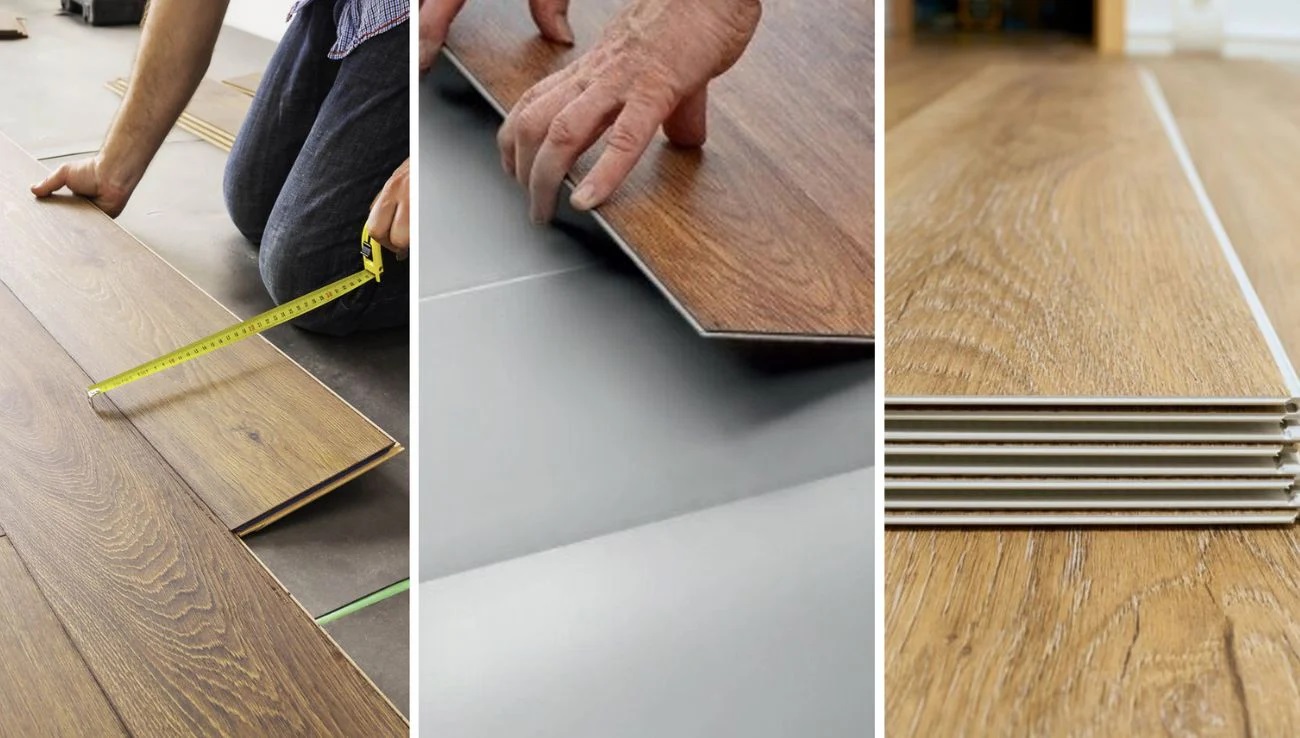
The wear layer is one of the first specifications buyers ask about, but it is often misunderstood. A 0.3 mm wear layer may be acceptable for price-sensitive residential programs, but it gives limited room for stronger commercial positioning. A 0.5 mm wear layer is a common choice for distributors that want a safer middle ground across residential and light commercial use. A 0.7 mm wear layer is usually reserved for heavier traffic, project bidding, or markets where the buyer wants a stronger durability claim.
| Wear layer | Typical positioning | Buyer risk to check |
| 0.3 mm | Budget residential, rental refresh, promotion SKUs | Overstated warranty, weak scratch story |
| 0.5 mm | Mainstream retail, distribution, light commercial | Needs stable coating and click machining |
| 0.7 mm | Commercial projects, higher traffic areas | Higher cost, longer approval cycle |
Wear layer alone does not define product performance. Coating quality, embossing depth, click strength, core density, backing type, and dimensional stability also matter. Ask whether the supplier can provide abrasion, stain, indentation, and dimensional stability records. ASTM F2199, a test method for dimensional stability after heat exposure, is especially useful when buyers worry about shrinkage, curling, or gapping.
Red flag: A supplier claims “commercial grade” based only on 0.5 mm or 0.7 mm wear layer without sharing test data or installation limits.
Click System, Core Stability, and Batch Consistency
Importers should treat click machining and core stability as claim-prevention items.
SPC flooring complaints often come from issues the buyer cannot fully see in showroom samples: weak click engagement, brittle edges, inconsistent milling, plank bowing, curling, or shade variation between batches. A sample board may look acceptable, but container-level consistency is what protects the importer’s margin.
Ask the supplier to define click tolerance and inspection method. For example, how many planks are checked per batch? Are length, width, squareness, straightness, and locking strength recorded? Are retained samples kept for each production run? These questions matter because distributors often reorder the same SKU after 60–180 days, and a visible color or embossing change can create retailer complaints.
Core formula should also be discussed carefully. Higher filler content may reduce cost, but it can affect brittleness, density, and machining performance. The supplier should be able to explain product density range, backing type, and recommended installation conditions. ISO 9001, a quality management system standard, does not prove product performance by itself, but it can show whether the factory has repeatable process controls.
What to ask your supplier/vendor: “Do you keep batch samples, and how long can you support the same décor, embossing, locking profile, and carton design for reorders?”
MOQ, Sampling, Lead Time, and Private Label Packaging
The buying process should be planned around real container economics, not only sample approval.
For importers, MOQ affects cash flow, color range, warehousing, and launch speed. Anyway Floor’s published FAQ states an MOQ of one 20-foot container with 3 colors from the E-catalog and an average production lead time of 35 days after deposit. These are useful planning figures, but buyers should confirm the current MOQ, color mix, packaging requirements, and production schedule before every order.
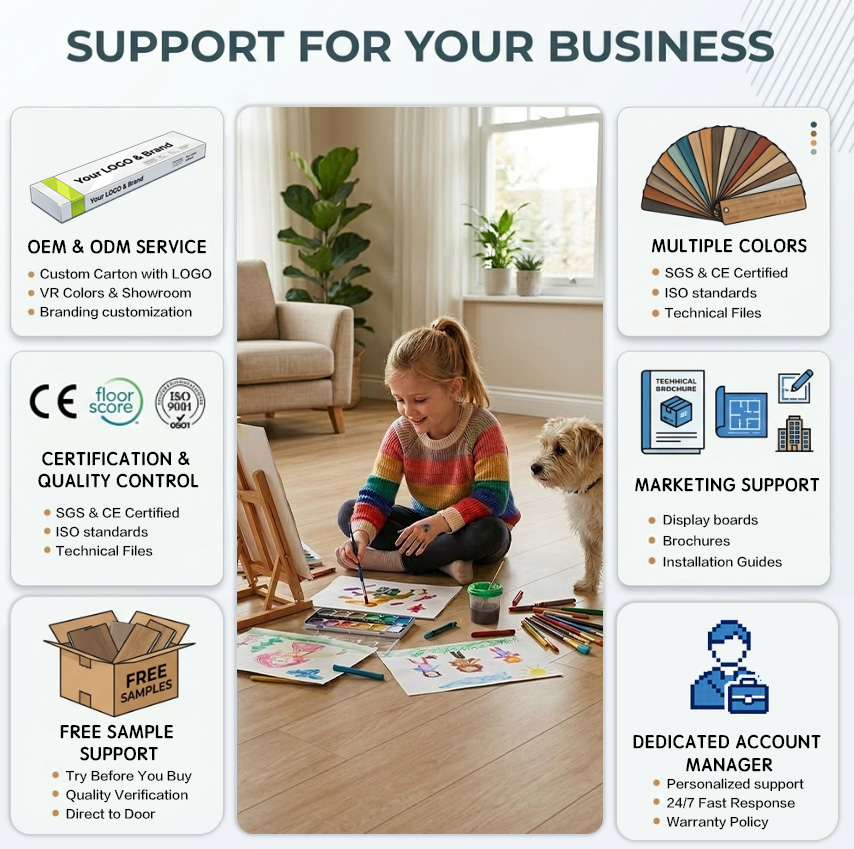
Sampling should test more than appearance. Ask for full-size planks when possible, not only small cut pieces. Review the click feel, edge strength, backing adhesion, décor repeat, surface texture, gloss level, carton label, and installation guide. For private label buyers, packaging should be approved before mass production, including carton artwork, barcode, pallet mark, user instructions, and warranty wording.
| Buying item | What to confirm before deposit |
| MOQ | Container size, color mix, SKU limits |
| Sampling | Full plank or cut sample, sample fee, courier time |
| Lead time | Production days after deposit, peak-season buffer |
| Private label | Carton design, barcode, pallet label, insert sheet |
| Reorders | Décor continuity, batch sample retention, forecast plan |
Red flag: The supplier accepts private label packaging but does not send carton dielines, barcode proof, or pallet label samples before production.
QC Checklist Before Mass Production and Shipment
QC should be built into the order process before the deposit, not added after goods are ready.
MOQ: Confirm one 20-foot container, color mix limit, SKU quantity, and current policy.
Lead time: Confirm average production time, current queue, and shipping document schedule.
Payment terms: Confirm deposit ratio, balance timing, and inspection-before-balance option.
Sample policy: Request full-size planks, color swatches, backing sample, and approved carton sample.
Documentation: Ask for spec sheet, installation guide, warranty draft, test reports, and packing list format.
Inspection: Check thickness, wear layer, plank size, squareness, click, surface defects, carton strength, and pallet condition.
Re-order consistency: Require retained batch samples for color, embossing, gloss, click profile, and packaging.
Certifications: Confirm ASTM F3261, FloorScore, ISO 9001, CE, or other market-specific documents when required by your customers.
Before shipment, importers should inspect both product and packaging. A strong SPC plank can still arrive with crushed corners if carton strength, pallet stacking, and container loading are not controlled.
What to ask: “Can we approve a pre-production sample, conduct mid-production checks, and inspect finished goods before balance payment?”
Common questions buyers ask
Serious buyers usually ask about risk control, repeat orders, claims, and documentation.
How many colors should I launch in the first SPC flooring container?
Many importers start with 3 colors in one container to reduce inventory risk while still giving retailers a basic range. Choose one neutral oak, one warm tone, and one gray or beige tone based on your local market.
Is 0.5 mm wear layer enough for light commercial use?
Often yes, but only when the full construction supports the claim. Check total thickness, coating, click strength, dimensional stability, installation limits, and warranty wording before positioning the product as light commercial.
Should I ask for full-size samples before placing an order?
Yes. Small cut samples are useful for color screening, but full-size planks reveal click feel, plank rigidity, embossing, backing, edge quality, and installation behavior more clearly.
What should I inspect before shipment?
Inspect at least thickness, wear layer, plank dimensions, surface defects, click engagement, carton label, barcode, pallet marks, and loading condition. For first orders, third-party inspection is worth considering before balance payment.
How do I reduce reorder mismatch?
Ask the supplier to keep retained batch samples and record décor code, embossing plate, gloss level, backing type, carton version, and production date. Reconfirm these items before every repeat order.
Red flag: A supplier cannot connect your reorder SKU to a retained sample, production batch, or original approved specification.
CTA conclusion
The safest SPC flooring order starts with a clear specification sheet, verified samples, and a QC plan before deposit.
Before placing your next SPC flooring container order, prepare your target market, planned colors, wear layer, thickness, backing type, packaging needs, and required certifications. Send your specification request and receive a matched SPC flooring option, sample plan, and QC checklist within 2 business days — one clear sourcing plan for your next shipment.
What to prepare: Target market, expected order size, preferred thickness, wear layer, color direction, private label needs, and required documents.

 Русский
 English
 العربية
 Français
 Español
 Português
 Deutsch
 italiano
 日本語
日本語 한국어
한국어 Nederlands
 Tiếng Việt
 ไทย
ไทย Polski
 Türkçe
 አማርኛ
አማርኛ Bahasa Melayu
 ဗမာစာ
ဗမာစာ Filipino
 Bahasa Indonesia
 magyar
 Română
 Čeština
 Српски
 हिन्दी
 فارسی
فارسی Kiswahili
 Slovenčina
 Slovenščina
 Norsk
Norsk Svenska
 українська
 Ελληνικά
 Suomi
Suomi Հայերեն
 עברית
עברית Dansk
Dansk اردو
اردو বাংলা
বাংলা Hrvatski
 Eesti keel
 नेपाली
 latviešu
 Euskara
 Български
 Català
 Hausa
Hausa íslenska
 Lietuvių
 Malti
Malti isiZulu